



When a neighboring excavation goes deeper than your existing foundation, or a building needs more capacity than its footings can provide, the structure has to be supported in a new way. Choosing the right method is one of the most consequential early decisions on a site with adjacent structures. Experienced underpinning contractors will tell you that no single technique fits every building, soil profile, or schedule.
This article compares three widely used approaches: mass concrete underpinning pits, micropiles, and jet grouting. It covers how each one works, where it performs well, and what to weigh before committing to a scope.
What Underpinning Is Meant to Do
Underpinning transfers building loads to a deeper or stronger bearing stratum, or increases the capacity of an existing foundation. Typical triggers include:
- Excavation next to an existing structure that exposes or undermines its footings
- Basement deepening or building expansion
- Settlement caused by weak, loose, or variable soils
- Added loads from new floors or changed building use
- Nearby tunneling, dewatering, or heavy construction activity
The goal is the same in every case: keep the structure stable and within tolerable movement while work proceeds. How you get there depends on depth, access, soil, groundwater, and the sensitivity of the building.
Mass Concrete Underpinning Pits
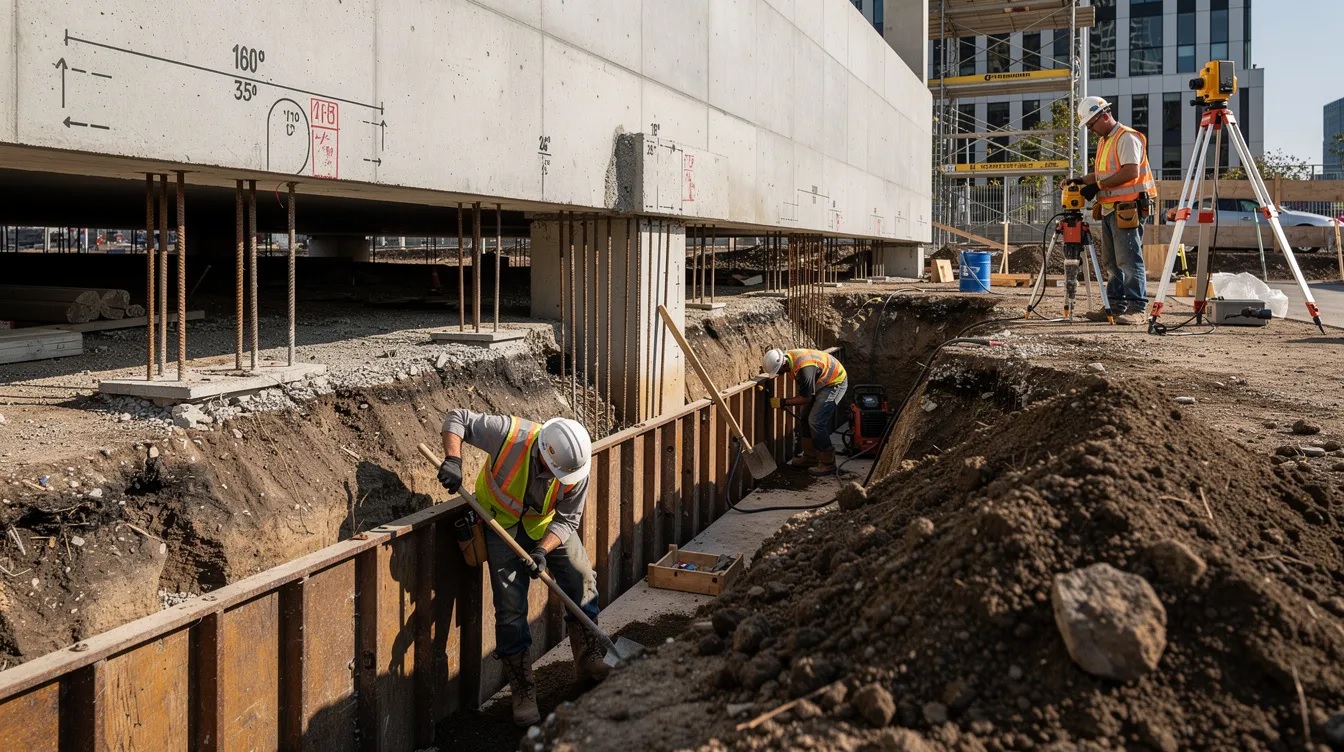
The traditional method is still common for good reasons. Crews excavate short, hand-dug or machine-assisted pits beneath an existing footing in a planned sequence, then fill each pit with concrete. Once the concrete has cured and been dry-packed against the underside of the footing, the process moves to the next pit.
Where it works well
- Shallow to moderate depths, where competent bearing soil is reachable
- Stable soils that stand open during short-duration excavation
- Sites without high groundwater
- Projects where the existing footing is continuous and in reasonable condition
Limitations to consider
- Sequencing is strict. Pits are typically excavated in alternating patterns so that only a limited length of footing is unsupported at any time.
- Groundwater, caving soils, and obstructions can make pit excavation slow or unsafe.
- Depth is limited. As pits get deeper, the volume of excavation and concrete rises quickly, and so does the risk.
- The work is labor-intensive and can be difficult in tight basements.
Mass concrete pits are often economical when conditions suit them. The tradeoff is that they offer little flexibility when conditions turn out to be worse than expected.
Micropiles
Micropiles are small-diameter, drilled and grouted piles with steel reinforcement. They are installed through or alongside existing foundations and transfer loads to deeper competent soil or rock. Because the drilling equipment can be compact, micropiles are well suited to restricted spaces.
Where it works well
- Low-headroom areas, such as basements and mechanical rooms, where compact rigs can operate
- Sites with deep or variable bearing layers
- Conditions with obstructions, fill, or rock that make other methods difficult
- Projects needing high capacity in a small footprint
- Settings with vibration limits, since drilling can be done with relatively low disturbance
Limitations to consider
- Connection details matter. The load transfer between the existing foundation and the new piles must be designed carefully, and it is a frequent source of field questions.
- Cost per unit can be higher than shallow methods, though it often compares favorably once depth, access, and risk are factored in.
- Drilling and grouting generate spoil and fluids that need management, particularly indoors.
- Buckling and lateral capacity should be checked in soft or loose upper soils.
Micropiles are a go-to option when the building must stay in service or when conditions rule out open excavation beneath the footing.
Jet Grouting
Jet grouting uses high-pressure fluid to erode and mix the soil in place with cement grout, forming columns or panels of soil-cement. For underpinning, those columns can carry load, strengthen weak ground beneath a footing, or form a mass that supports the foundation during adjacent excavation.
Where it works well
- Soils that are difficult to treat otherwise, from soft clays to granular materials
- Areas where equipment must work through small openings or from limited headroom
- Projects where ground improvement and groundwater cutoff are both needed
- Situations where existing utilities or structures make conventional excavation impractical
Limitations to consider
- The result depends on soil type, parameters, and workmanship. Column diameter and strength can vary, so verification is essential.
- Spoil return is significant and needs a handling plan.
- Heave or ground disturbance can occur if parameters and sequencing are not controlled.
- Testing and monitoring requirements are often more involved than for other methods.
The reliability of jet grouting rises with preparation. Trial columns, coring, and unconfined compressive testing give the design team real data instead of assumptions. Qualified jet grouting contractors typically recommend a test program before production begins.
How the Three Methods Compare
| Factor | Mass Concrete Pits | Micropiles | Jet Grouting |
| Typical depth | Shallow to moderate | Shallow to very deep | Moderate to deep |
| Access needs | Hand or small equipment | Compact rigs, low headroom possible | Compact rigs possible, spoil handling required |
| Groundwater tolerance | Limited | Good | Good |
| Obstruction tolerance | Limited | Good | Varies with soil |
| Schedule predictability | Dependent on sequencing | Generally predictable | Dependent on testing and verification |
| Quality control focus | Bearing, fit-up, dry-pack | Grout, connection, load tests | Column size, strength, coring |
These are general tendencies. Site-specific conditions can change the picture quickly, so treat the table as a starting point for discussion rather than a selection tool.
Factors That Drive the Decision
Soil and groundwater. The geotechnical report should guide the first screening. Caving sands below the water table steer you away from open pits. Soft clays may favor deep foundations or treated ground.
Depth of the required support. The deeper the bearing layer, the less practical shallow pits become.
Building condition and sensitivity. Older masonry structures tolerate very little movement. Historic buildings add preservation constraints and often call for lower-disturbance techniques and tighter monitoring.
Access and headroom. A basement with 7 feet of clearance and a single door opening is a very different problem from an open exterior footing.
Schedule and phasing. Some methods can run in parallel across multiple work faces. Others must be performed sequentially.
Monitoring and acceptance criteria. Define movement thresholds, instrumentation, and response triggers before work begins, not after the first reading comes in high.
Planning Considerations That Apply to Any Method
- Involve specialists early. Selection and design work best when the specialty team can review the geotechnical data, the building drawings, and the excavation plan together.
- Survey existing conditions. A pre-construction condition survey protects everyone involved if questions about cracking or movement come up later.
- Define responsibility for design. Clear scope boundaries between the engineer of record, the specialty designer, and the general contractor prevent delays during submittals.
- Instrument the structure. Settlement points, tiltmeters, and crack gauges give early warning and a documented record.
- Plan for the unexpected. Contingency in schedule and budget for obstructions, voids, or weaker-than-expected soil is far cheaper than redesign mid-stream.
Making the Right Call
Mass concrete pits, micropiles, and jet grouting each have a place. Pits are straightforward where soils and depth allow. Micropiles offer capacity and flexibility in difficult access. Jet grouting addresses ground that other methods struggle to treat. Often the best answer is a combination, applied where each method fits best along the structure.
The most reliable outcomes come from selecting the method based on data, designing it with the full construction sequence in mind, and verifying performance in the field. Teams that bring specialty input in during planning, rather than after bids are in, tend to avoid the redesign and schedule pressure that follow a poor initial match.